

T-Duality and Flavor Symmetries in Little String Theories
Authors
Hamza Ahmed, Paul-Konstantin Oehlmann, Fabian Ruehle
Abstract
We explore the T-duality web of 6D Heterotic Little String Theories, focusing on flavor algebra reducing deformations. A careful analysis of the full flavor algebra, including Abelian factors, shows that the flavor rank is preserved under T-duality. This suggests a new T-duality invariant in addition to the Coulomb branch dimension and the two-group structure constants. We also engineer Little String Theories with non-simply laced flavor algebras, whose appearance we attribute to certain discrete 3-form fluxes in M-theory. Geometrically, these theories are engineered in F-theory with non-Kähler favorable K3 fibers. This geometric origin leads us to propose that freezing fluxes are preserved across T-duality. Along the way, we discuss various exotic models, including two inequivalent $\text{Spin(32)}/\mathbb{Z}_2$ models that are dual to the same $\text{E}_8 \times \text{E}_8$ theory, and a family of self-T-dual models.
Concepts
The Big Picture
Imagine two seemingly different maps of the same city, with different street names and different neighborhood boundaries, but describing the exact same place from different perspectives. This is roughly what T-duality does in string theory: it relates two physically distinct-looking theories that turn out to be secretly equivalent when you peel back the mathematical surface.
Among six-dimensional quantum field theories, Little String Theories (LSTs) occupy an unusual middle ground. They’re more exotic than the standard particle physics toolkit, but less encompassing than full theories of quantum gravity. String-scale physics governs their behavior, and properties of fundamental strings remain meaningful even at lower energies, unlike most features of ordinary quantum field theories.
A team from Northeastern University (Hamza Ahmed, Paul-Konstantin Oehlmann, and Fabian Ruehle) has now discovered a new T-duality invariant. The rank of the flavor symmetry algebra, a count of how many independent “directions” a theory’s internal symmetry group can point in, is preserved when you T-dualize a Heterotic LST. This holds even when the flavor symmetry itself changes dramatically.
Key Insight: The rank of the flavor symmetry group is a previously unrecognized invariant of T-duality in Little String Theories, joining the Coulomb branch dimension and two-group structure constants as a conserved quantity that constrains the T-duality web.
How It Works
The setting is six-dimensional Heterotic Little String Theories, arising from stacking NS5-branes (extended, membrane-like objects higher-dimensional than strings themselves) in a background with a transverse orbifold singularity, a geometric space with a sharp, cone-like point formed by folding a smooth space along a symmetry. The flavor symmetries come from the 10-dimensional gauge groups of Heterotic string theory, either E₈ × E₈ or Spin(32)/ℤ₂, which break down to smaller residual flavor algebras G_F when you specify “holonomies” controlling how gauge fields wind around the compact direction.
Geometrically, T-duality corresponds to something elegant. Two T-dual theories are literally the same Calabi-Yau threefold (a six-real-dimensional curved space used to compactify string theory) viewed through two different elliptic fibration structures: different choices of which torus-shaped fibers count as “the” elliptic fibers. The challenge is identifying which physical quantities survive this change of perspective.
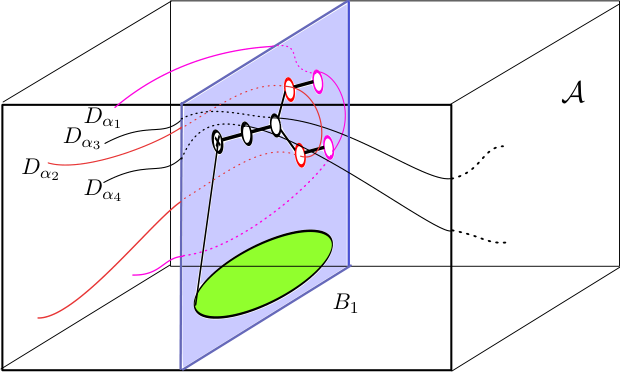
The main technical hurdle the authors overcome is properly accounting for Abelian flavor symmetries, the U(1) factors that the simplest continuous symmetries take (like rotations in a single plane). These are routinely overlooked in flavor algebra analyses. The U(1)s arise from three distinct sources:
- Genuine flavor symmetries from the gauge sector
- Baryonic symmetries, tied to conserved charges from how matter particles combine
- E-string symmetries, tied to exceptional strings that appear when the tensor branch is activated
Some of these U(1)s get broken by ABJ anomalies (Adler-Bell-Jackiw anomalies, quantum effects that violate classical symmetries). The authors carefully track all contributions and show that even after anomaly breaking, the total rank of G_F, counting all surviving U(1)s plus the non-Abelian factors, remains constant across T-duality. This is non-trivial bookkeeping that previous analyses missed.
The second major contribution involves non-simply laced flavor algebras. In the Lie algebra classification of continuous symmetry groups, “simply laced” algebras (A, D, E types) have all symmetry generators of equal “length,” while non-simply laced algebras (B, C, F, G types) have generators of mixed lengths. These asymmetric structures are harder to engineer geometrically.
The authors trace their appearance to discrete 3-form fluxes in M-theory, background fields threading compact dimensions like magnetic flux through a loop, but taking only discrete allowed values. These “freezing fluxes” require, in F-theory language, non-Kähler favorable K3 fibers: compact geometric surfaces whose structure falls outside the standard toric computational toolkit most commonly used to handle these spaces.
The construction has three routes:
- Starting from SCFTs with non-simply laced flavor and taking a gravity decoupling limit
- Fusing simpler LST building blocks along shared boundaries
- Directly constructing from non-favorable K3 geometries in F-theory
Each route produces consistent LSTs, and the authors verify that T-duality maps these exotic theories to each other while preserving the flavor rank throughout.
Why It Matters
Flavor rank as a T-duality invariant tightens the constraints on the landscape of consistent string vacua. Every new invariant is another handle on the classification problem: figuring out which theories can exist and how they connect. The authors also uncover genuinely exotic specimens. Two inequivalent Spin(32)/ℤ₂ theories are both T-dual to the same E₈ × E₈ theory, violating naive expectations about T-duality being a clean one-to-one correspondence and revealing unexpected branching structure in the duality web.
The proposal that freezing fluxes are preserved under T-duality is the deepest structural claim in the paper. If correct, it explains why non-simply laced flavor algebras survive T-duality and gives a geometric foothold for understanding M-theory backgrounds that are otherwise hard to characterize. The authors also find a family of self-T-dual models, theories that map to themselves under T-duality, pointing toward fixed-point structure in the duality web that warrants further study.
Bottom Line: By carefully tracking Abelian flavor factors and discrete fluxes, this work establishes flavor rank as a new T-duality invariant in Little String Theories and opens a geometric window onto exotic models with non-simply laced symmetries that were previously out of reach.
IAIFI Research Highlights

This work combines algebraic geometry (toric constructions, K3 fibrations) with quantum field theory techniques to classify six-dimensional string theories, reflecting the mathematical physics approach central to IAIFI's research mission.

While primarily theoretical physics, the systematic classification of T-duality invariants parallels symmetry-discovery problems where machine learning tools are increasingly applied in string theory landscape explorations.

The paper identifies flavor rank as a new conserved quantity under T-duality in Little String Theories and proposes that freezing fluxes are preserved across T-duality, advancing our picture of string theory's non-perturbative structure.
Future work will likely extend this invariant analysis to non-Heterotic LSTs and explore whether freezing flux preservation constrains M-theory compactifications more broadly; see [arXiv:2311.02168](https://arxiv.org/abs/2311.02168) for the full analysis.
Original Paper Details
T-Duality and Flavor Symmetries in Little String Theories
2311.02168
["Hamza Ahmed", "Paul-Konstantin Oehlmann", "Fabian Ruehle"]
We explore the T-duality web of 6D Heterotic Little String Theories, focusing on flavor algebra reducing deformations. A careful analysis of the full flavor algebra, including Abelian factors, shows that the flavor rank is preserved under T-duality. This suggests a new T-duality invariant in addition to the Coulomb branch dimension and the two-group structure constants. We also engineer Little String Theories with non-simply laced flavor algebras, whose appearance we attribute to certain discrete 3-form fluxes in M-theory. Geometrically, these theories are engineered in F-theory with non-Kähler favorable K3 fibers. This geometric origin leads us to propose that freezing fluxes are preserved across T-duality. Along the way, we discuss various exotic models, including two inequivalent $\text{Spin(32)}/\mathbb{Z}_2$ models that are dual to the same $\text{E}_8 \times \text{E}_8$ theory, and a family of self-T-dual models.