

The DREAMS Project: Disentangling the Impact of Halo-to-Halo Variance and Baryonic Feedback on Milky Way Satellite Galaxies
Authors
Jonah C. Rose, Mariangela Lisanti, Paul Torrey, Francisco Villaescusa-Navarro, Alex M. Garcia, Arya Farahi, Carrie Filion, Alyson M. Brooks, Nitya Kallivayalil, Kassidy E. Kollmann, Ethan Lilie, Jiaxuan Li, Olivia Mostow, Akaxia Cruz, Tri Nguyen, Sandip Roy, Andrew B. Pace, Niusha Ahvazi, Stephanie O'Neil, Xuejian Shen, Francis-Yan Cyr-Racine, Adrian M. Price-Whelan, Marla Geha, Lina Necib, Mark Vogelsberger, Julian B. Muñoz, Julianne J. Dalcanton
Abstract
We analyze the properties of satellite galaxies around 1,024 Milky Way-mass hosts from the DREAMS Project, simulated within a $Λ$CDM cosmology. Utilizing the TNG galaxy-formation model, the DREAMS simulations incorporate both baryonic physics and cosmological uncertainties for a large sample of galaxies with diverse environments and formation histories. We investigate the relative impact of the physical uncertainty from the galaxy-formation model on predicted satellite properties using four metrics: the satellite stellar mass function, radial distribution, inner slope of dark matter density profile, and stellar half-light radius. We compare these predictions to observations from the SAGA Survey and the DREAMS N-body simulations and find that uncertainties from baryonic physics modeling are subdominant to the scatter arising from halo-to-halo variance. Where baryonic modeling does affect satellites, the supernova wind energy has the largest effect on the satellite properties that we investigate. Specifically, increased supernova wind energy suppresses the stellar mass of satellites and results in more extended stellar half-light radii. The adopted wind speed has only a minor impact, and other astrophysical and cosmological parameters show no measurable effect. Our findings highlight the robustness of satellite properties against uncertainties in baryonic physics modeling.
Concepts
The Big Picture
Imagine trying to understand traffic patterns in a city by studying just ten intersections, then wondering whether your conclusions apply to the whole metropolis. That’s the challenge astronomers face when modeling the Milky Way’s satellite galaxies: tiny, faint dwarf galaxies orbiting our home galaxy, each one a window into the universe’s darkest and smallest structures. For decades, researchers have built elaborate computer simulations to predict what these satellites should look like. But a nagging question persists: when simulations disagree with observations, is it because our physics models are wrong, or just because every Milky Way is a little different?
The DREAMS Project (Dark Matter and Astrophysics with Machine Learning and Simulations) goes after this question directly. By simulating 1,024 Milky Way-mass host galaxies, far more than most previous efforts, researchers led by Jonah Rose and Mariangela Lisanti at Princeton set out to quantify exactly how much the assumed physics of galaxy formation matters compared to the natural diversity of galaxies themselves. The answer is clear: the messiness of the cosmos, not the messiness of our equations, drives most of what we see in satellite galaxy populations.
Key Insight: The natural variation from galaxy to galaxy swamps the uncertainty from how we model star formation and stellar explosions. Our satellite galaxy predictions are far more stable than previously feared, and observations primarily reflect the diverse formation histories of individual galaxies rather than flaws in the underlying model.
How It Works
Each of the 1,024 host galaxies was simulated using the TNG galaxy-formation model, best known from the IllustrisTNG suite. It’s a widely used physics recipe specifying how gas cools, stars form, supernovae explode, and black holes grow. To probe the role of physics assumptions, the team ran simulations across a grid of baryonic and cosmological parameters, adjusting everything from how much energy supernovae pump into surrounding gas to the rate of cosmic expansion.
For each simulated galaxy, the researchers tracked four properties of the satellite population:
- Satellite stellar mass function: how many satellites exist at each mass scale
- Radial distribution: how far satellites orbit from their host
- Inner slope of the dark matter density profile: the steepness of the dark matter concentration at each satellite’s core
- Stellar half-light radius: how physically extended each satellite’s stars are
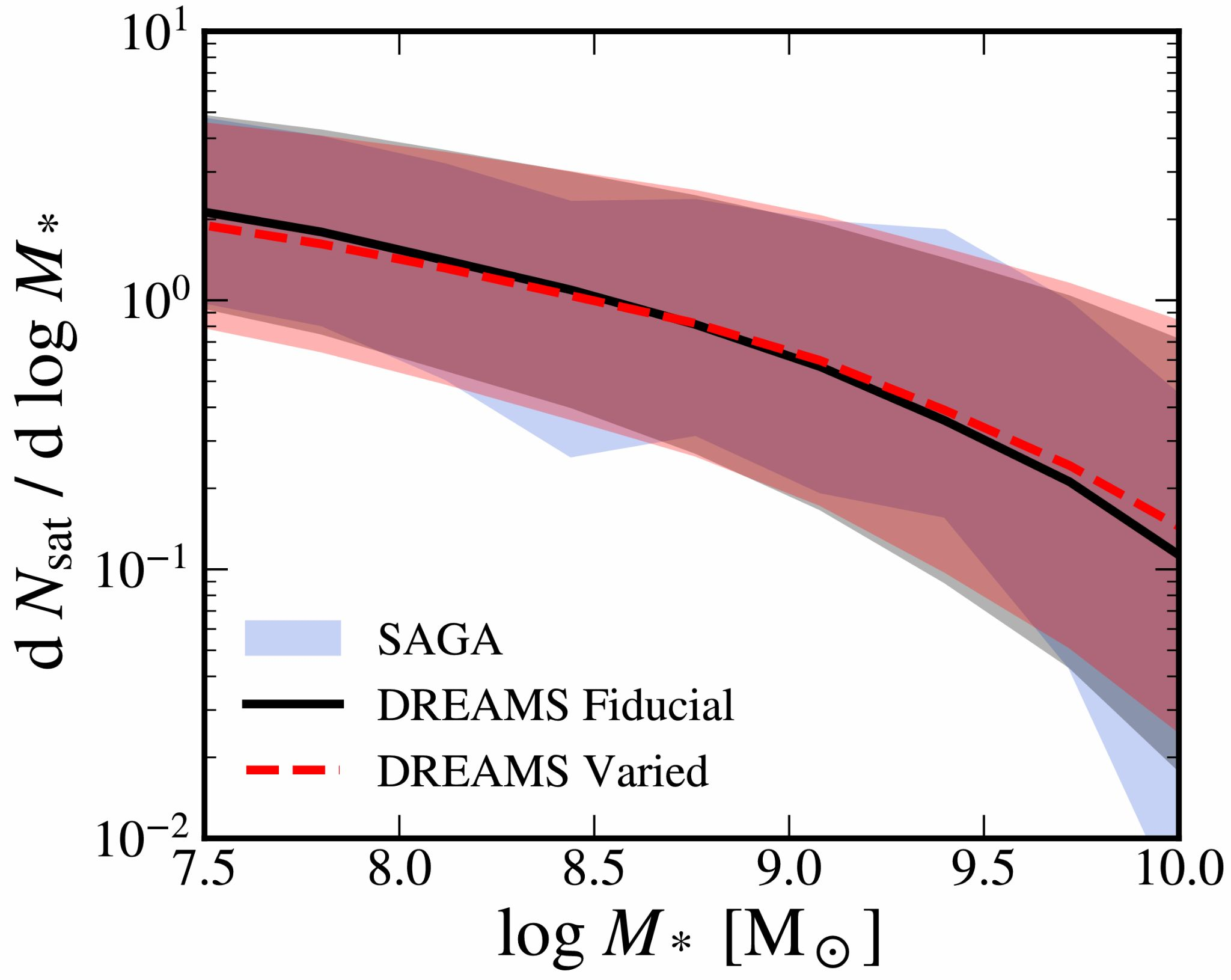
The team compared these predictions against two benchmarks: the SAGA Survey, which observes satellite galaxies around 101 nearby Milky Way analogs in the real universe, and a companion set of N-body (dark matter-only) DREAMS simulations that strip away baryonic physics entirely. By stacking results across all 1,024 hosts and across all parameter variations, they could separate the signal of physics uncertainty from the noise of natural galaxy-to-galaxy variation.
The results are telling. Plot the predicted satellite stellar mass function for different physics settings, and the curves pile nearly on top of one another. But the cloud of galaxy-to-galaxy variation engulfs them all. No matter how you tune the supernova model or cosmological parameters within observationally allowed ranges, the diversity of galaxy formation histories produces a far wider spread than the model uncertainty itself.
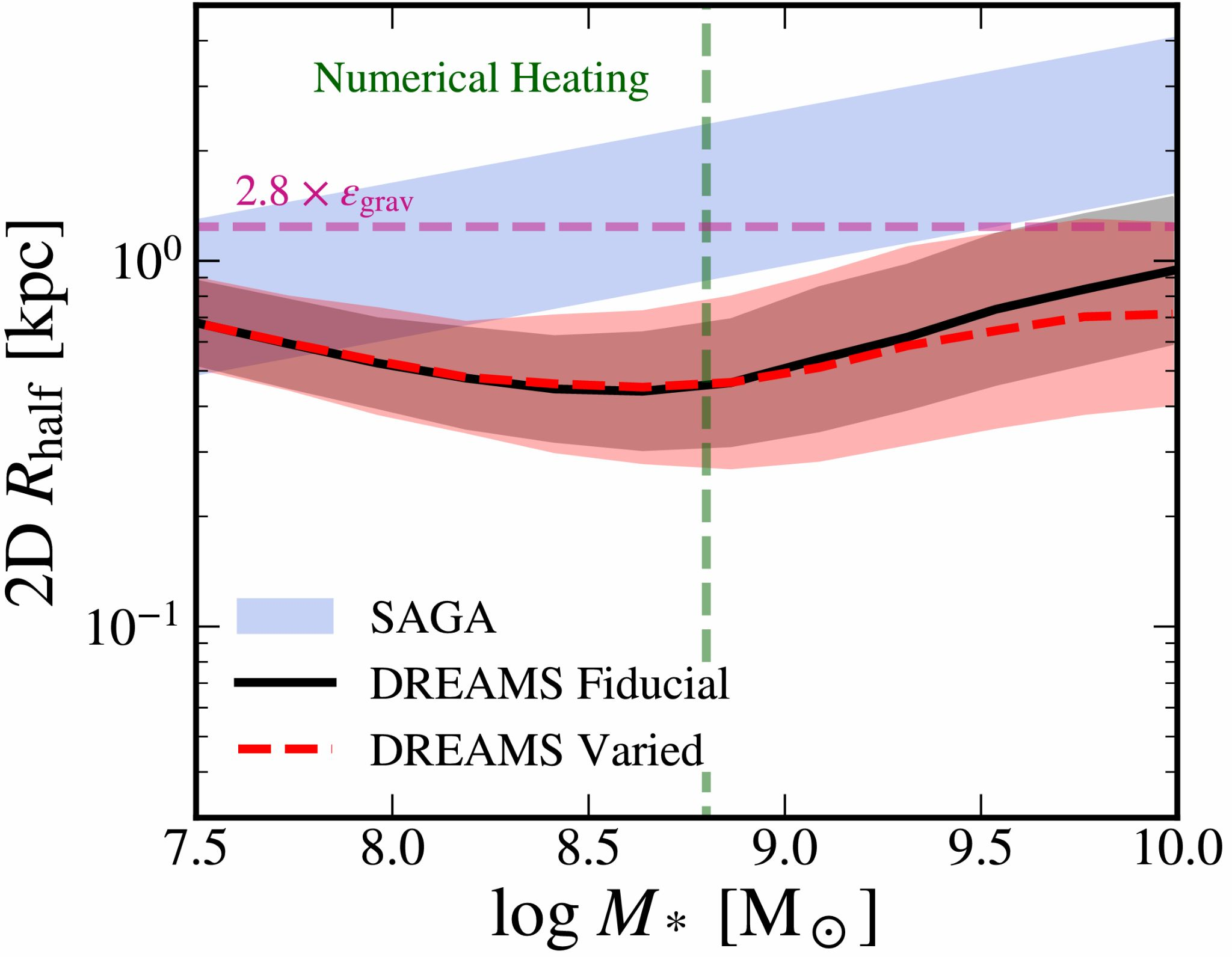
One parameter does stand out, though. Supernova wind energy (the total kinetic energy injected into surrounding gas when massive stars explode) leaves a measurable imprint. Cranking up wind energy suppresses satellite stellar masses and produces more spatially extended stellar distributions. The physics is intuitive: stronger winds push gas outward before it can collapse into stars, leaving satellites less centrally concentrated.
Wind speed, by contrast, has only a minor effect. Parameters governing black holes, cosmic expansion, and other processes show essentially no measurable signal.
Why It Matters
Satellite galaxies are among the best laboratories we have for probing dark matter behavior on scales smaller than a single galaxy. Competing theories (warm dark matter, self-interacting dark matter, various ultralight candidates) all predict different satellite populations. Before we can use observations to rule models in or out, we need to know how much observed scatter in satellite properties comes from dark matter physics versus galaxy formation physics.
DREAMS settles that question on the galaxy-formation side: the physics uncertainty is small. Departures from standard ΛCDM predictions in observed satellites are more likely to signal exotic dark matter than poorly modeled stellar explosions or black hole activity.
This points toward a shift in strategy for computational cosmology. Rather than spending computational resources on ever-finer resolution for a handful of systems, future surveys may gain more from expanding the statistical sample of hosts. Diversity, not model tuning, dominates the total prediction uncertainty. The DREAMS framework, with its large ensemble simulations and systematic parameter variation, offers a template for moving beyond simulating one galaxy at a time. And the SAGA Survey comparison lends confidence that the TNG model captures the essential physics at this mass scale.
Bottom Line: With 1,024 simulated Milky Way analogs, the DREAMS Project shows that satellite galaxy properties hold up well against uncertainty in baryonic physics. The cosmos’s own diversity, not our model imprecision, is the main source of theoretical scatter when comparing simulations to observations.
IAIFI Research Highlights

The DREAMS Project combines large-scale hydrodynamical simulation ensembles with systematic parameter sweeps across baryonic and cosmological uncertainties, connecting computational astrophysics and statistical inference to disentangle physical from cosmic variance in satellite galaxy populations.

The DREAMS framework provides a richly varied dataset of 1,024 host galaxies with controlled parameter variation, exactly the kind of large-scale simulation suite needed to train and validate machine learning emulators for cosmological inference.

By showing that satellite galaxy properties are insensitive to baryonic physics modeling uncertainties, these results sharpen satellites as probes of dark matter physics, making them more reliable discriminators between standard cosmological predictions and alternative dark matter models.
Future DREAMS analyses will extend to additional satellite observables and use the simulation suite for simulation-based inference on dark matter properties; the paper is available at [arXiv:2512.02095](https://arxiv.org/abs/2512.02095).