

The Frozen Phase of Heterotic F-theory Duality
Authors
Paul-Konstantin Oehlmann, Fabian Ruehle, Benjamin Sung
Abstract
We study the duality between the Spin$(32)/\mathbb{Z}_2$ heterotic string without vector structure and F-theory with frozen singularities. We give a complete description in theories with $6$d $\mathcal{N}=(1,0)$ supersymmetry and identify the duals of Spin$(32)/\mathbb{Z}_2$-instantons on ADE singularities without vector structure in the frozen phase of F-theory using an ansatz introduced by Bhardwaj, Morrison, Tachikawa, and Tomasiello. As a consequence, we obtain a strongly coupled description of orbifold phases of type I string theory without vector structure, substantially expanding the list of known examples of $6$d F-theory compactifications with frozen singularities. Supergravity theories can be fused from these instanton theories, in a way that commutes with switching off vector structure, which we use to propose new consistency checks via neutral hypermultiplet counting. Finally, we describe various Higgsings of this duality, and comment on constraints on higher form symmetries.
Concepts
The Big Picture
Imagine trying to describe the same city using two completely different maps: one showing street-level detail, the other satellite imagery. If both maps agree, you gain confidence they’re both accurate. String theory works the same way. Physicists compare different mathematical descriptions of the same physical reality to uncover deeper truths. When descriptions agree, they validate each other. When they don’t, that’s where new physics hides.
Two of string theory’s most powerful frameworks, the heterotic string and F-theory, are known to be “dual” to each other in certain situations. They describe identical physics from radically different vantage points, like two languages that tell the same story when translated correctly.
But there’s a peculiar, poorly understood corner of this relationship called the frozen phase, where certain geometric features in F-theory become permanently locked, impossible to smooth away or adjust. Picture a wrinkle in spacetime fabric that’s been permanently set: visible but unmovable. This frozen territory has resisted systematic exploration for decades.
A team at Northeastern University and UC Santa Barbara has now mapped this frozen terrain for a rich class of six-dimensional theories, filling a long-standing gap in the string theory landscape.
Key Insight: Certain mysterious “frozen” singularities in F-theory have precise heterotic string duals, and tracking these dualities yields new consistency checks for string compactifications that were previously out of reach.
How It Works
The Spin(32)/Z₂ heterotic string is one of the five original superstring theories. String theory requires extra dimensions beyond the four we experience, and these extra dimensions must be curled up, or “compactified,” into geometric shapes too small to detect directly. This particular string has an unusual variant: it can be compactified “without vector structure,” a subtle topological twist that changes the gauge symmetry (the mathematical rules governing how fundamental forces behave) and matter content of the resulting theory. The effect is like threading a Möbius strip through the compactification. Winding around the extra dimensions forces you to identify gauge fields in a twisted way.
The dual F-theory description involves frozen singularities, specifically special orientifold planes called O7⁺-planes. These carry positive charge (unusual, since most orientifold planes carry negative charge) and arise when a discrete flux threads through a geometric singularity. Here’s the subtlety: a frozen singularity looks geometrically identical to an unfrozen one. You cannot tell them apart just by staring at the Calabi-Yau manifold (the geometric shape formed by the extra dimensions). Detecting the difference requires physical data, which is exactly what heterotic duality provides.
The researchers attacked this problem through a three-step program:
-
Construct heterotic orbifold theories. Start with the Spin(32)/Z₂ string, then send small instantons (point-like concentrations of gauge field energy) to collide with ADE singularities (geometric defects classified by a standard mathematical taxonomy: the An series, Dn series, and exceptional E6, E7, E8 types). In the “without vector structure” setting, these instantons behave differently from their ordinary counterparts, producing new gauge theories and matter spectra.
-
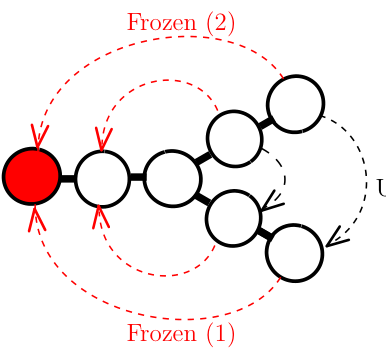
Apply the frozen rules. Using an ansatz developed by Bhardwaj, Morrison, Tachikawa, and Tomasiello, the team translated each heterotic orbifold theory into its F-theory dual. These “frozen rules” specify which singularity types get frozen and how matter content transforms, functioning as a precise translation manual between the two string theory languages.
-
Fuse local theories into global ones. Individual instanton theories describe local physics near a singularity. To build complete six-dimensional supergravity theories, the researchers fused multiple local building blocks together. They show this fusion process commutes with turning off vector structure, meaning the two operations can be performed in either order and give the same answer.
One sharp consistency check comes from neutral hypermultiplets, massless particles that carry no gauge charge. Two related heterotic theories that differ only by whether vector structure is activated must have identical neutral hypermultiplet counts. This is non-trivial: it means freezing has a precise, verifiable signature. The team completed the An singularity cases fully and made substantial progress on the Dn and Em cases, producing a near-complete classification of this duality in six dimensions.
Why It Matters
The swampland program is the ongoing effort to separate physically consistent theories of quantum gravity from the vast space of seemingly plausible but actually inconsistent theories. F-theory has been the dominant tool for enumerating consistent string vacua, but the frozen phase was a blind spot. Each new frozen example either confirms existing swampland conjectures or reveals previously unknown constraints.
The paper also opens a window onto higher-form symmetries in the frozen phase. Higher-form symmetries generalize ordinary symmetry to charged objects that are not point particles but extended strings or surfaces. The team derives bounds on the 1-form symmetry sector showing that the frozen phase imposes constraints absent in the unfrozen setting, connecting to the broader question of which discrete global symmetries are compatible with quantum gravity.
The duality also provides a strongly coupled description of orbifold phases of Type I string theory (another of the five original superstring theories) without vector structure. These theories were previously inaccessible through direct perturbative methods.
Bottom Line: By systematically mapping the frozen corner of heterotic–F-theory duality in six dimensions, this paper expands the known string landscape, delivers new consistency constraints via hypermultiplet counting, and raises new questions about discrete symmetries in quantum gravity.
IAIFI Research Highlights

This work brings together algebraic geometry, Lie theory, and string duality to solve a classification problem at the frontier of theoretical physics, combining the kind of cross-disciplinary methods central to IAIFI's mission.

The systematic, rule-based classification of string vacua is the type of problem where machine learning methods could automate and extend the search at far greater scale.

The paper delivers a complete duality map in the Spin(32)/Z₂ heterotic–F-theory framework with frozen singularities, expanding the catalog of consistent six-dimensional string vacua and providing new consistency conditions via neutral hypermultiplet counting.
Future directions include extending the frozen duality map to four-dimensional compactifications and applying these consistency checks to constrain the broader swampland program; the full analysis is available at [arXiv:2404.02191](https://arxiv.org/abs/2404.02191).
Original Paper Details
The Frozen Phase of Heterotic F-theory Duality
2404.02191
["Paul-Konstantin Oehlmann", "Fabian Ruehle", "Benjamin Sung"]
We study the duality between the Spin$(32)/\mathbb{Z}_2$ heterotic string without vector structure and F-theory with frozen singularities. We give a complete description in theories with $6$d $\mathcal{N}=(1,0)$ supersymmetry and identify the duals of Spin$(32)/\mathbb{Z}_2$-instantons on ADE singularities without vector structure in the frozen phase of F-theory using an ansatz introduced by Bhardwaj, Morrison, Tachikawa, and Tomasiello. As a consequence, we obtain a strongly coupled description of orbifold phases of type I string theory without vector structure, substantially expanding the list of known examples of $6$d F-theory compactifications with frozen singularities. Supergravity theories can be fused from these instanton theories, in a way that commutes with switching off vector structure, which we use to propose new consistency checks via neutral hypermultiplet counting. Finally, we describe various Higgsings of this duality, and comment on constraints on higher form symmetries.