

The Landscape of Unstable Mass Transfer in Interacting Binaries and Its Imprint on the Population of Luminous Red Novae
Authors
Angela A. G. Twum, Alejandro Vigna-Gómez, Morgan MacLeod, Rosa Wallace Everson, Ricardo Yarza, V. Ashley Villar, Enrico Ramirez-Ruiz
Abstract
A common-envelope (CE) phase occurs when a star engulfs its companion and is widely considered the primary channel for producing Luminous Red Novae (LRNe). In this study, we combine binary-population synthesis with stellar-evolution calculations to systematically estimate the mass, velocity, and launching radius of ejecta produced during coalescence across a range of binary configurations. Our aim is to quantify how unstable mass-transfer dynamics in binaries at various evolutionary stages shape CE outcomes, enabling a predictive framework for modeling the LRN luminosity function. We find a bimodal distribution of plateau luminosities with significant implications for binary mass stability criteria that can be tested with forthcoming LSST observations. This bimodality emerges from differing mass-ejection outcomes during common-envelope interactions, which can lead either to stellar mergers, often accompanied by tidal disruption of the companion, or to successful envelope ejection. Although our predicted plateau luminosities and timescales broadly match existing observations, the models underpredict the number of LRNe with long-duration plateaus ($t_p \gtrsim 100\, \text{d}$) by about a third. We propose that these long-duration events arise from highly extended progenitors whose envelopes are ejected over multiple orbits (i.e., non-impulsively), producing relatively faint, long-lived transients. By constraining ejecta properties and incorporating pre-outburst progenitor imaging, we show how our models can clarify the physical processes that drive unstable mass transfer in these events. Finally, we argue that common-envelope interactions involving white-dwarf accretors can yield exotic outcomes, including red giants containing embedded white dwarfs that resemble Thorne-Żytków objects (TŻOs), along with calcium-rich supernovae that preserve hydrogen envelopes.
Concepts
The Big Picture
Imagine two stars locked in a gravitational embrace, circling each other for millions of years. Then one swells into a bloated red giant and begins spilling its outer layers onto its smaller companion. What happens next can be catastrophic: the giant’s outer gas engulfs the companion entirely, both stars spiraling inward through a shared cocoon of hot gas.
This is a common-envelope (CE) phase, so called because both stars share a single gaseous envelope. CE events are among the most violent and poorly understood processes in stellar physics, and they produce Luminous Red Novae (LRNe), long-lived transients that can shine for weeks or months as the merger plays out.
For decades, astronomers have struggled to predict what these mergers look like from Earth. How bright will they be? How long will they last? The answers depend on messy details: how much material gets flung off during the death spiral, at what speed, and from where in the system.
A new study by Angela Twum and collaborators takes a systematic approach, combining population-level statistics with detailed stellar physics to build a predictive framework for LRN outcomes across different binary star configurations. The result is a map of stellar catastrophe, predicting not just what LRNe look like but why they come in different flavors, and what future telescopes should expect when they start catching thousands of them.
Key Insight: Common-envelope mergers produce a two-peaked distribution of LRN brightnesses, a bimodal “fingerprint” that encodes how stars share and shed mass. Upcoming sky surveys are uniquely positioned to test this prediction.
How It Works
The team’s approach combines two ingredients. Binary population synthesis (BPS) simulates the life histories of millions of binary star pairs, tracking how their masses, orbital separations, and evolutionary states change over cosmic time. Detailed stellar evolution models then capture the internal structure of the donor star at the moment of mass transfer, letting the team calculate how ejected material behaves.
For each binary configuration, the researchers compute three properties of the ejecta (the material flung outward during the merger):
- Ejecta mass — how much material gets expelled
- Ejecta velocity — how fast it leaves the system
- Launching radius — where in the binary the material originates
These three numbers feed into a model for how hydrogen recombination powers the LRN light curve. As ejected gas cools, electrons settle back onto hydrogen atoms and release light. This process sets two observable quantities: the plateau luminosity (how bright the event appears during its extended flat phase) and the plateau duration (how long that brightness holds).
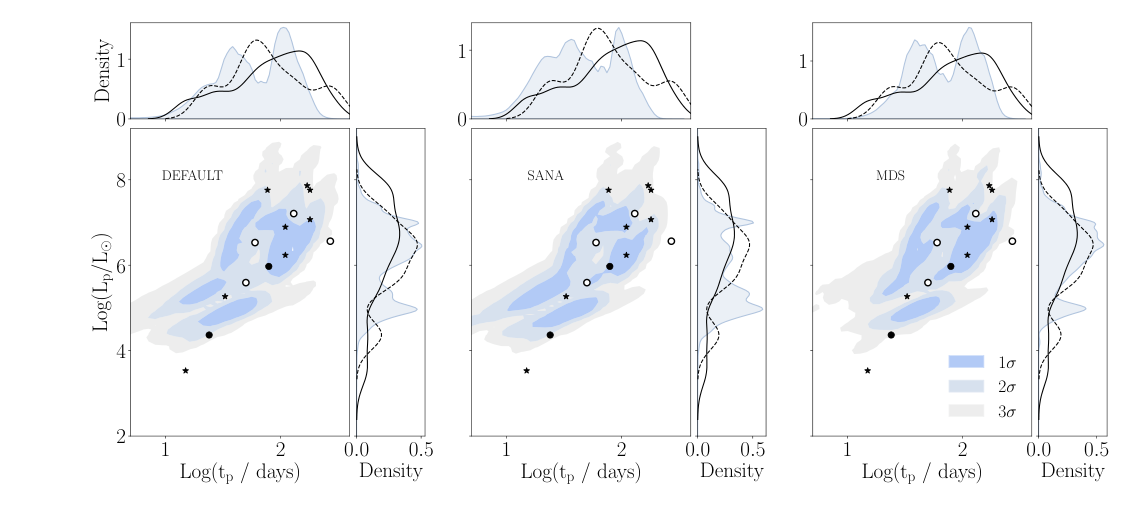
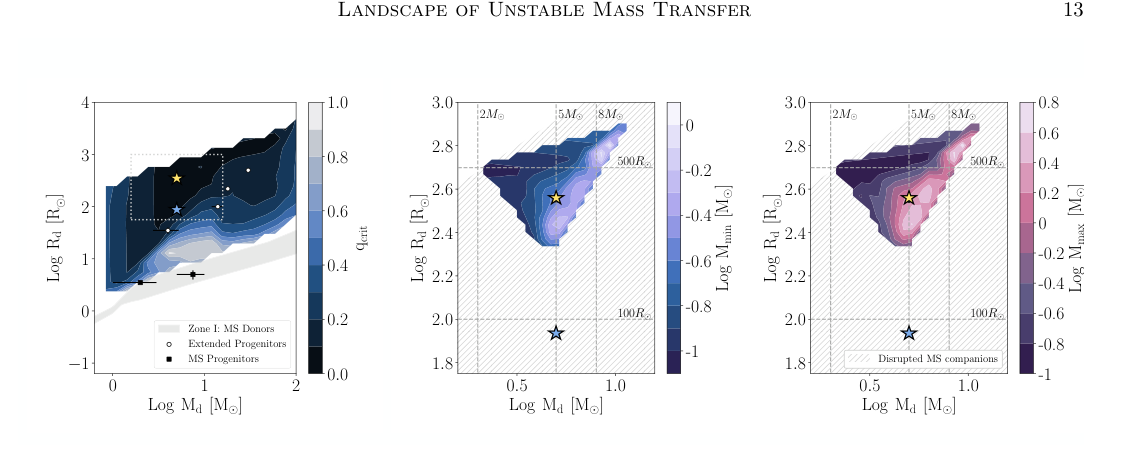
The headline result is a bimodal distribution of plateau luminosities: two distinct peaks in the brightness histogram rather than a smooth continuum. This bimodality traces back to two different CE outcomes. In one, the companion survives and successfully ejects the donor’s outer layers, producing a brighter, shorter event. In the other, the companion is tidally disrupted, shredded as it spirals too deep into the donor before the outer layers can escape. That produces a fainter, longer transient.
The models broadly match existing LRN observations but reveal a gap: they underpredict long-duration events (plateau durations exceeding 100 days) by about a third. The likely explanation is that these slow-burning LRNe come from massive precursor stars with enormous radii. Their outer layers don’t get flung off in a single sudden burst but peel away gradually over multiple orbital periods. Any model that assumes a single rapid ejection will miss this faint, long-lived signal.
Why It Matters
The Vera C. Rubin Observatory’s Legacy Survey of Space and Time (LSST) will detect LRNe by the dozens, potentially hundreds, per year within this decade. Without a theoretical baseline, classifying these transients in real time will be a serious challenge. The bimodal luminosity distribution gives astronomers a concrete, testable prediction that either confirms or challenges our current picture of mass-transfer stability in binaries.
The same common-envelope interactions that produce LRNe are also the primary pathway for creating compact binary systems: the pairs of neutron stars and black holes that eventually merge and produce gravitational waves detectable by LIGO. Most gravitational wave events we observe likely passed through a CE phase billions of years ago. Getting CE physics right matters for interpreting the gravitational wave sky, not just the optical one.
The study also turns up exotic endpoints for CE interactions involving white dwarf accretors (white dwarfs actively drawing in matter from a companion). These can produce red giants with embedded white dwarfs that mimic Thorne-Żytków objects, or calcium-rich supernovae that retain their outer hydrogen layers. Both are rare, poorly understood phenomena that may be lurking unrecognized in existing catalogs.
Bottom Line: By mapping how binary star configurations translate into specific LRN brightness and duration, this work provides the first predictive framework for stellar merger transients, giving astronomers a baseline for interpreting the coming wave of LSST discoveries and connecting these events to the broader story of compact binary formation and gravitational waves.
IAIFI Research Highlights
The Landscape of Unstable Mass Transfer in Interacting Binaries and Its Imprint on the Population of Luminous Red Novae
2602.10211
Angela A. G. Twum, Alejandro Vigna-Gómez, Morgan MacLeod, Rosa Wallace Everson, Ricardo Yarza, V. Ashley Villar, Enrico Ramirez-Ruiz
A common-envelope (CE) phase occurs when a star engulfs its companion and is widely considered the primary channel for producing Luminous Red Novae (LRNe). In this study, we combine binary-population synthesis with stellar-evolution calculations to systematically estimate the mass, velocity, and launching radius of ejecta produced during coalescence across a range of binary configurations. Our aim is to quantify how unstable mass-transfer dynamics in binaries at various evolutionary stages shape CE outcomes, enabling a predictive framework for modeling the LRN luminosity function. We find a bimodal distribution of plateau luminosities with significant implications for binary mass stability criteria that can be tested with forthcoming LSST observations. This bimodality emerges from differing mass-ejection outcomes during common-envelope interactions, which can lead either to stellar mergers, often accompanied by tidal disruption of the companion, or to successful envelope ejection. Although our predicted plateau luminosities and timescales broadly match existing observations, the models underpredict the number of LRNe with long-duration plateaus ($t_p \gtrsim 100\, \text{d}$) by about a third. We propose that these long-duration events arise from highly extended progenitors whose envelopes are ejected over multiple orbits (i.e., non-impulsively), producing relatively faint, long-lived transients. By constraining ejecta properties and incorporating pre-outburst progenitor imaging, we show how our models can clarify the physical processes that drive unstable mass transfer in these events. Finally, we argue that common-envelope interactions involving white-dwarf accretors can yield exotic outcomes, including red giants containing embedded white dwarfs that resemble Thorne-Żytków objects (TŻOs), along with calcium-rich supernovae that preserve hydrogen envelopes.