

The Luminous and Double-Peaked Type Ic Supernova 2019stc: Evidence for Multiple Energy Sources
Authors
Sebastian Gomez, Edo Berger, Griffin Hosseinzadeh, Peter K. Blanchard, Matt Nicholl, V. Ashley Villar
Abstract
We present optical photometry and spectroscopy of SN\,2019stc (=ZTF19acbonaa), an unusual Type Ic supernova (SN Ic) at a redshift of $z=0.117$. SN\,2019stc exhibits a broad double-peaked light curve, with the first peak having an absolute magnitude of $M_r=-20.0$ mag, and the second peak, about 80 rest-frame days later, $M_r=-19.2$ mag. The total radiated energy is large, $E_{\rm rad}\approx 2.5\times 10^{50}$ erg. Despite its large luminosity, approaching those of Type I superluminous supernovae (SLSNe), SN\,2019stc exhibits a typical SN Ic spectrum, bridging the gap between SLSNe and SNe Ic. The spectra indicate the presence of Fe-peak elements, but modeling of the first light curve peak with radioactive heating alone leads to an unusually high nickel mass fraction of $f_{\rm Ni}\approx 31\%$ ($M_{\rm Ni}\approx 3.2$ M$_\odot$). Instead, if we model the first peak with a combined magnetar spin-down and radioactive heating model we find a better match with $M_{\rm ej}\approx 4$ M$_\odot$, a magnetar spin period of $P_{\rm spin}\approx 7.2$ ms and magnetic field of $B\approx 10^{14}$ G, and $f_{\rm Ni}\lesssim 0.2$ (consistent with SNe Ic). The prominent second peak cannot be naturally accommodated with radioactive heating or magnetar spin-down, but instead can be explained as circumstellar interaction with $\approx 0.7$ $M_\odot$ of hydrogen-free material located $\approx 400$ AU from the progenitor. Including the remnant mass leads to a CO core mass prior to explosion of $\approx 6.5$ M$_\odot$. The host galaxy has a metallicity of $\approx 0.26$ Z$_\odot$, low for SNe Ic but consistent with SLSNe. Overall, we find that SN\,2019stc is a transition object between normal SNe Ic and SLSNe.
Concepts
The Big Picture
Imagine watching a fireworks show where one explosive launches two distinct bursts of light, separated by nearly three months, each blazing as bright as billions of stars. That’s roughly what astronomers saw when SN 2019stc went off in the fall of 2019: a stellar death so strange it didn’t fit any standard explanation.
When massive stars exhaust their nuclear fuel, they collapse catastrophically, triggering supernova explosions. Type Ic supernovae, explosions from stars that shed their outer layers of hydrogen and helium before dying, are well-understood. They shine predictably, powered by radioactive nickel slowly decaying inside the expanding debris cloud.
SN 2019stc broke the pattern. It was far brighter than a typical Type Ic event, yet its spectrum (the characteristic pattern of colors in its light, which reveals what chemical elements are present) looked completely ordinary. More baffling still, it produced two distinct brightness peaks separated by 80 days, something radioactive decay simply cannot explain.
A team of Harvard & Smithsonian astronomers, led by Sebastian Gomez and Edo Berger, tracked this supernova across more than a year of observations and pieced together a surprising solution: SN 2019stc required not one, not two, but three distinct energy sources working in sequence.
Key Insight: SN 2019stc is a cosmic Rosetta Stone. A single supernova displays features of two entirely different explosion classes, suggesting that the boundary between ordinary stripped-core supernovae and their ultra-luminous cousins is far blurrier than astronomers assumed.
How It Works
The team gathered brightness measurements in four color bands (optical filters labeled g, r, i, and z) using three telescopes: the 1.2-m FLWO and the 6.5-m Magellan and MMT observatories. Data from the Zwicky Transient Facility (ZTF), the robotic sky survey that first spotted the transient on September 30, 2019, filled in the early light curve.
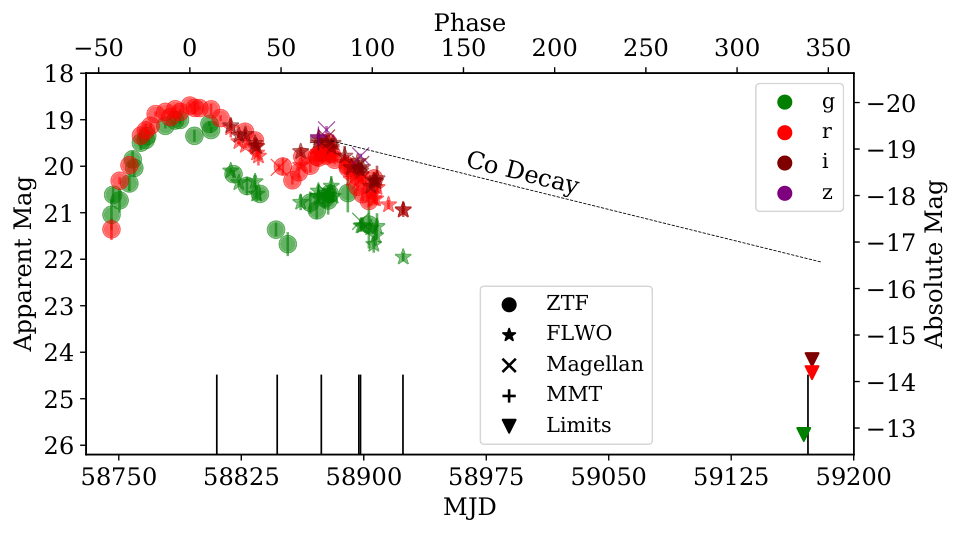
The light curve was immediately puzzling. The first peak hit an absolute magnitude of M_r = −20.0, already approaching Type I superluminous supernovae (SLSNe), the rarest and brightest class of stellar explosions. Total radiated energy: approximately 2.5 × 10^50 erg. Then, instead of fading as nickel decays into cobalt and iron, SN 2019stc brightened again 80 days later, peaking at M_r = −19.2.
The researchers tried the standard explanation first: pure radioactive nickel heating, the process by which nickel forged in the explosion releases energy as it decays, powering the supernova’s glow over weeks. The math was brutal. Explaining the first peak with nickel alone would require 3.2 solar masses of nickel, or 31% of the total ejected mass. Normal Type Ic events have nickel fractions of 5–30% at far lower absolute amounts. Physically implausible.
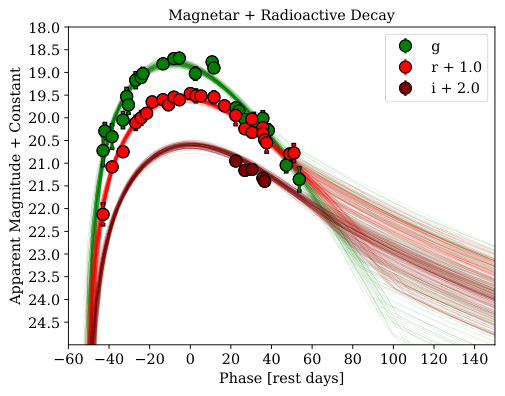
The better solution involved a magnetar engine: a newly-formed neutron star spinning hundreds of times per second, its rapid rotation bleeding energy into the surrounding gas like an electromagnetic dynamo. Fitting the first peak with a combined magnetar-plus-nickel model produced far more reasonable numbers:
- Ejecta mass: ~4 solar masses
- Magnetar spin period: ~7.2 milliseconds
- Magnetic field strength: ~10^14 Gauss
- Nickel fraction: ≤20%, consistent with normal SNe Ic
This explained why the spectrum looked ordinary. The nickel content was actually normal; the magnetar was simply adding extra luminosity on top.
The second peak still needed explaining. Neither radioactive decay nor magnetar spin-down naturally produces a delayed re-brightening of this magnitude. The team turned to a third mechanism: circumstellar interaction (CSI), where the supernova debris slams into gas the dying star had shed before it exploded. That collision converts kinetic energy into light, producing a second flare weeks or months after the initial explosion.
The numbers work. About 0.7 solar masses of hydrogen-free material sat roughly 400 AU from the progenitor. The ejecta, traveling at thousands of kilometers per second, took roughly 80 days to reach it. The collision produced a second peak nearly as bright as the first.
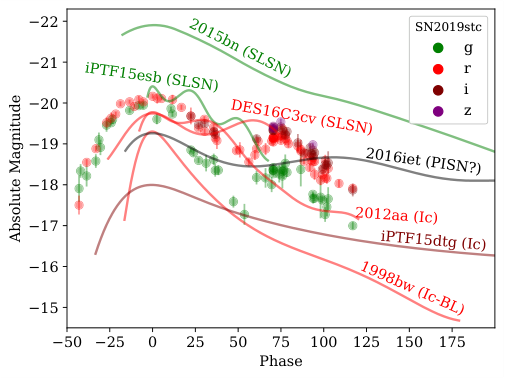
Adding up all mass components, the team inferred a carbon-oxygen core mass of about 6.5 solar masses just before explosion. The host galaxy’s metallicity (the abundance of elements heavier than hydrogen and helium) sits at ~0.26 solar metallicities, which is low for typical SNe Ic environments but consistent with where SLSNe tend to occur.
Why It Matters
SN 2019stc sits in the luminosity gap between normal stripped supernovae and their superluminous cousins. Only a handful of events with peak magnitudes between −19 and −20 are known, and each one helps answer a basic question: are SLSNe a completely distinct population, or is there a continuous spectrum connecting them to ordinary core collapses?
SN 2019stc argues for continuity. The same kind of progenitor, a stripped, moderately massive star in a low-metallicity galaxy, can apparently produce a normal SN Ic, a superluminous event, or something in between. What matters is whether a magnetar forms and whether the star shed circumstellar material before dying. This has practical implications for next-generation facilities like the Rubin Observatory’s Legacy Survey of Space and Time, which will find thousands of supernovae per night. The intermediate zone where SN 2019stc lives may turn out to be far more populated than anyone expected.
Bottom Line: SN 2019stc required a magnetar, radioactive nickel, and circumstellar interaction to explain its double-peaked light curve. It is the clearest evidence yet that these explosion classes exist on a continuum rather than in separate bins.
IAIFI Research Highlights

This work combines observational astronomy across multiple facilities with physical modeling to decode a multi-mechanism transient. Neither the data nor the theory alone could explain what was happening; the answer emerged only from fitting multiple models against coordinated observations.

The FLEET program that flagged SN 2019stc for follow-up uses machine learning to identify luminous extragalactic transients in real time from ZTF data streams. Without that automated triage, this event might have gone unnoticed in the flood of nightly alerts.

SN 2019stc shows that magnetar formation, radioactive nucleosynthesis, and pre-explosion mass loss can all operate simultaneously in a single stellar death, constraining the physical conditions at the final stages of massive star evolution and the birth of neutron stars.
Future time-domain surveys will likely uncover a population of similar transitional events; this paper provides the analytical framework for interpreting them. The full analysis is presented by Gomez et al. (2021) in *The Astrophysical Journal* ([arXiv:2103.02611](https://arxiv.org/abs/2103.02611)).