

Theoretical Predictions for the Inner Dark Matter Distribution in the Milky Way Informed by Simulations
Authors
Abdelaziz Hussein, Lina Necib, Manoj Kaplinghat, Stacy Y. Kim, Andrew Wetzel, Justin I. Read, Martin P. Rey, Oscar Agertz
Abstract
We build a theoretical range for the Milky Way's (MW) inner dark matter (DM) distribution informed by the FIRE-2, Auriga, VINTERGATAN-GM, and TNG50 simulation suites assuming the canonical cold dark matter (CDM) model. The DM density profiles in Auriga, VINTERGATAN-GM, and TNG50 can be approximately modeled using the adiabatic contraction prescription of Gnedin et al. 2004, while FIRE-2 has stronger baryonic feedback, leading to a departure from the adiabatic contraction model. The simulated halos that are adiabatically contracted are close to spherical (axis ratio $q \in [0.75-0.9]$ at $5^\circ$), whereas halos that experience strong baryonic feedback are oblate ($q \in [0.5-0.7]$). Using the adiabatic contraction and strong baryonic feedback models, along with the observed stellar distribution of the MW, the inner logarithmic density slope for CDM in the MW is predicted to range from $ -0.5$ to $-1.3$. The $J$-factor, which determines the DM-annihilation flux, averaged over a solid angle of $5^\circ$ ($10^\circ$) is predicted to span the range $0.8$-$30$ ($0.6$-$10$) $\times 10^{23} \rm{GeV}^2/\rm{cm}^5$. The $D$-factor, which determines the flux due to DM decay, is predicted to be in the range $0.6$-$2$ ($0.5-1$) $\times10^{23} \rm{GeV}/\rm{cm}^2$. GitHub: The results for this work can be found at https://github.com/abdelazizhussein/MW-Inner-DM-Profile.
Concepts
The Big Picture
Imagine trying to find something you’ve never seen, hiding inside a room so crowded with furniture that you can barely move, and the lights are off. That’s roughly the challenge facing astronomers trying to map dark matter in the heart of our own galaxy.
The Milky Way’s center is one of the most extreme environments in the universe. Dust chokes out visible light, billions of stars blur together in tight clusters, and ordinary matter dominates so thoroughly that the dark matter signal is nearly impossible to tease out.
Dark matter makes up roughly 85% of all matter in the universe, yet we’ve never detected it directly. We know it’s there because its gravity shapes galaxies, bends light, and drives cosmic structure. But where exactly it sits, especially deep in the core of our own galaxy, remains stubbornly uncertain.
That uncertainty has real consequences. Searches for signals produced when dark matter particles collide or decay depend on knowing how much dark matter is packed into the galactic center. A factor of 10 uncertainty in density translates directly to a factor of 100 uncertainty in the expected signal.
A team led by Abdelaziz Hussein and Lina Necib at MIT took a new approach. Instead of measuring the dark matter distribution directly (which tracking individual stellar motions can barely constrain within about 20,000 light-years of the center), they bracketed the plausible range using four simulation suites of galaxy formation, anchored to what we actually observe about the Milky Way’s stars.
Key Insight: The physics of how ordinary matter reshapes dark matter halos, whether through gravitational contraction or explosive stellar feedback, lets the team define a theoretically grounded range for the Milky Way’s inner dark matter profile. Instead of “anything goes,” detection experiments now have a physically motivated target window.
How It Works
When stars form in a galactic center, what happens to the dark matter? Two competing forces reshape the dark matter halo, the extended, roughly spherical cloud of dark matter enveloping a galaxy:
- Adiabatic contraction (AC): As ordinary matter accumulates in the galactic center, its gravity drags dark matter inward, creating a denser, sharper concentration called a cusp. Without any violent disruption, this is what you’d expect.
- Baryonic feedback: Supernovae, stellar winds, and AGN (active galactic nuclei, supermassive black holes in their energetic phase) drive repeated gas outflows. The gravitational potential fluctuates rapidly, flinging dark matter outward and carving out a shallower core instead.
The team analyzed six Milky Way-mass galaxies drawn from four simulation suites: Auriga, VINTERGATAN-GM, TNG50, and FIRE-2. Each implements these physical processes differently. Three suites (Auriga, VINTERGATAN-GM, TNG50) produce dark matter profiles that closely match the adiabatic contraction prescription of Gnedin et al. 2004. Stellar feedback in those models isn’t strong enough to disrupt the contraction. FIRE-2 is the outlier: its stronger feedback drives the inner dark matter distribution outward, puffing up the halo.
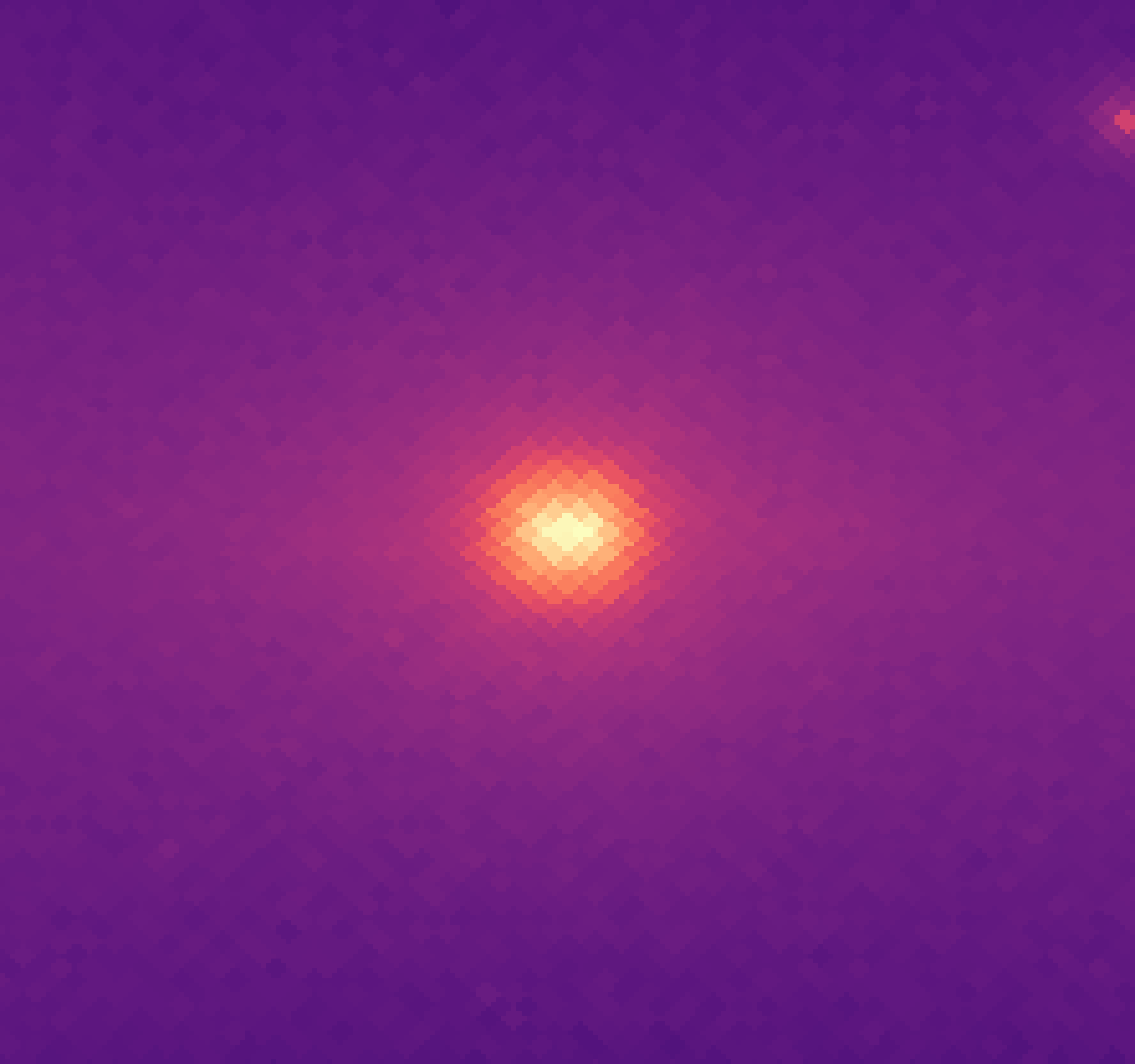
The ratio shown above tells the story. In FIRE-2, dark matter mass in the inner regions consistently falls below the AC prediction; feedback has won. In the other three suites, the ratio stays near 1.0, meaning AC dominates. These two regimes define the bookends of the team’s theoretical range.
With these simulation-calibrated models in hand, the researchers plugged in the observed stellar distribution of the actual Milky Way. They didn’t use simulated galaxies as direct stand-ins. Instead, they used the simulations to calibrate the physics, then applied that physics to real observations.
The result is a predicted inner density slope (how steeply dark matter density rises toward the galactic center) ranging from −0.5 (a shallow, feedback-scoured core) to −1.3 (a steep, adiabatically contracted cusp). The classic NFW profile, a standard theoretical baseline for how dark matter density varies with radius, has a slope of −1 at small radii. The team’s range spans shallower to slightly steeper than this benchmark.
Halo shape tells a parallel story. Adiabatically contracted halos are nearly spherical, with axis ratios q (where 1.0 is perfectly round) in the range [0.75–0.9] at 5° from the galactic center. FIRE-2-like halos are oblate, squashed along the disk axis, with q in [0.5–0.7]. This morphological difference matters for indirect detection searches, which routinely assume spherical symmetry.
Why It Matters
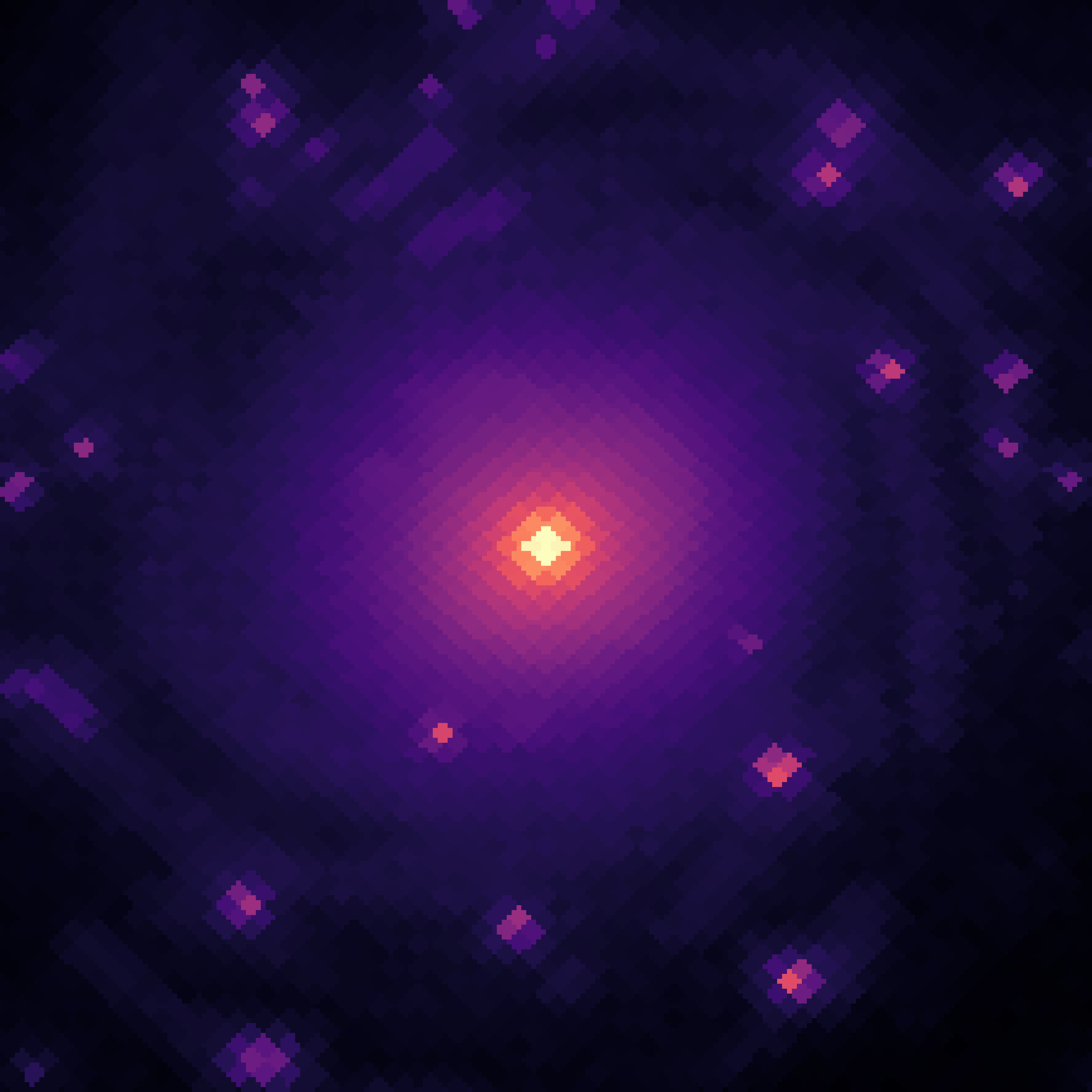
The J-factor, which governs how bright a signal from annihilating dark matter particles would appear from the galactic center, spans nearly two orders of magnitude across the team’s range: from 0.8 to 30 × 10²³ GeV²/cm⁵ when averaged over a 5° cone. The D-factor, governing signals from dark matter decay, ranges from 0.6 to 2 × 10²³ GeV/cm². These aren’t free parameters. They’re bounds derived from simulations anchored to real stellar data.
The profile shape itself turns out to be a major source of theoretical uncertainty, one that current gamma-ray searches from Fermi-LAT, neutrino surveys, and planned future experiments don’t always account for. Hussein and colleagues make clear that telling the two feedback regimes apart isn’t just an academic exercise; it’s a prerequisite for interpreting any claimed detection or upper limit from the galactic center.
Future surveys measuring stellar motions with unprecedented precision, combined with higher-resolution simulations, could eventually pin down which regime our galaxy actually inhabits.
Bottom Line: The Milky Way’s inner dark matter profile remains uncertain by a factor of ~40 in J-factor, but that uncertainty is now bracketed by physics rather than parametric freedom, giving dark matter hunters a well-defined target window.
IAIFI Research Highlights

This work combines cosmological simulation analysis, observational stellar data, and analytical dark matter physics to produce predictions that connect astrophysics and particle physics, drawing on approaches central to IAIFI's research program.

The framework treats simulation suites as physical emulators, calibrating complex subgrid physics models against observations and then transferring those learned relationships to real data. This simulation-to-observation pipeline is increasingly common in AI-assisted scientific inference.

Bounding the J- and D-factors with physically motivated models sharpens targets for indirect dark matter detection across gamma rays, neutrinos, and cosmic rays.
Future high-resolution stellar kinematic surveys and next-generation simulations may discriminate between the adiabatic contraction and strong feedback regimes in the actual Milky Way; the paper is available at [arXiv:2501.14868](https://arxiv.org/abs/2501.14868).
Original Paper Details
Theoretical Predictions for the Inner Dark Matter Distribution in the Milky Way Informed by Simulations
2501.14868
["Abdelaziz Hussein", "Lina Necib", "Manoj Kaplinghat", "Stacy Y. Kim", "Andrew Wetzel", "Justin I. Read", "Martin P. Rey", "Oscar Agertz"]
We build a theoretical range for the Milky Way's (MW) inner dark matter (DM) distribution informed by the FIRE-2, Auriga, VINTERGATAN-GM, and TNG50 simulation suites assuming the canonical cold dark matter (CDM) model. The DM density profiles in Auriga, VINTERGATAN-GM, and TNG50 can be approximately modeled using the adiabatic contraction prescription of Gnedin et al. 2004, while FIRE-2 has stronger baryonic feedback, leading to a departure from the adiabatic contraction model. The simulated halos that are adiabatically contracted are close to spherical (axis ratio $q \in [0.75-0.9]$ at $5^\circ$), whereas halos that experience strong baryonic feedback are oblate ($q \in [0.5-0.7]$). Using the adiabatic contraction and strong baryonic feedback models, along with the observed stellar distribution of the MW, the inner logarithmic density slope for CDM in the MW is predicted to range from $ -0.5$ to $-1.3$. The $J$-factor, which determines the DM-annihilation flux, averaged over a solid angle of $5^\circ$ ($10^\circ$) is predicted to span the range $0.8$-$30$ ($0.6$-$10$) $\times 10^{23} \rm{GeV}^2/\rm{cm}^5$. The $D$-factor, which determines the flux due to DM decay, is predicted to be in the range $0.6$-$2$ ($0.5-1$) $\times10^{23} \rm{GeV}/\rm{cm}^2$. GitHub: The results for this work can be found at https://github.com/abdelazizhussein/MW-Inner-DM-Profile.