

UV and Optical Signatures of Late-time Disk Instabilities in Tidal Disruption Events
Authors
Daichi Tsuna, V. Ashley Villar, Anthony L. Piro, Samantha C. Wu
Abstract
Tidal disruption events (TDEs) are unique probes of evolving accretion in supermassive black holes. Recent models of TDE disks show that they undergo brief thermal instabilities with temporal super-Eddington accretion at late times, which has been suggested as a possibility to explain the ubiquitous late radio emergence in TDEs. We model the ultraviolet (UV) and optical signatures of such disk instabilities, expected from the accretion power being reprocessed by the optically-thick outflow following super-Eddington accretion. Our model predicts brief UV-bright transients lasting for days, with luminosities of $10^{42}$-$10^{43}$ erg s$^{-1}$ in near-UV and $10^{41}$-$10^{42}$ erg s$^{-1}$ in optical for a typical TDE by a $10^6~M_\odot$ black hole. These could be detectable by near-future surveys such as ULTRASAT, Vera C. Rubin Observatory and Argus Array, for TDEs of redshifts out to $\approx 0.1$. We further conduct a search for these transients in existing nearby TDEs using data from the Zwicky Transient Facility, placing upper limits on the flare rate for each TDE of $1$-$2$ yr$^{-1}$ dependent on the outflow mass. In the era of future surveys, combined UV/optical and radio monitoring would be an important test to the disk instability phenomena, as well as its explanation for the late-time radio emission in TDEs.
Concepts
The Big Picture
Imagine a star like our Sun wandering too close to a supermassive black hole millions of times more massive. Tidal forces shred it like taffy, flinging half the stellar mass into space while the rest spirals inward, forming a blazing accretion disk around the black hole. Astronomers call this a tidal disruption event (TDE), and they’ve been watching them light up the sky for decades.
But these cosmic catastrophes hide a mystery in their afterglow. Hundreds to thousands of days after the initial stellar fireworks die down, many TDEs suddenly flare back to life in radio waves. Nobody fully understands why.
One leading hypothesis: the accretion disk becomes unstable long after the main event, triggering brief episodes of runaway accretion that dump material onto the black hole far faster than the system can stably handle. Now, a team including IAIFI member V. Ashley Villar has worked out what those instability flares should look like in ultraviolet and optical light, giving astronomers a concrete new target to hunt.
Their model predicts that each instability episode produces a brief, brilliant UV flash. They’ve also identified which upcoming sky surveys are best positioned to catch one.
Key Insight: Disk instabilities in TDEs should produce UV-bright flares lasting just a few days, with luminosities up to 10^43 erg/s. Next-generation surveys like ULTRASAT and the Rubin Observatory have the right combination of speed and sensitivity to detect them.
How It Works
The physics begins with the Eddington limit, the maximum luminosity a black hole can sustain without radiation pressure blowing away the infalling gas. For a million-solar-mass black hole, that corresponds to an accretion rate of roughly 0.01 solar masses per year. During a disk instability, the rate can spike to 4 solar masses per year, hundreds of times above the limit.
At these super-Eddington rates, the disk can’t radiate fast enough. Instead, it launches a powerful, dense outflow so packed with particles that light can’t pass through freely. Energy gets absorbed and re-radiated as heat. The team modeled this reprocessing physics in detail:
- The flare ejects 0.01–0.1 solar masses over roughly 1–2 days, a duration set by the disk’s viscous timescale (the time friction takes to transport material inward), which turns out to be nearly independent of black hole mass
- The wind expands outward from a characteristic launching radius, carrying accretion power with it
- As it expands, the wind cools, transitioning from hot UV-bright emission to cooler optical emission over days
- Once accretion shuts off, the photosphere (the wind’s outer surface, where light finally escapes freely) recedes and luminosity drops sharply
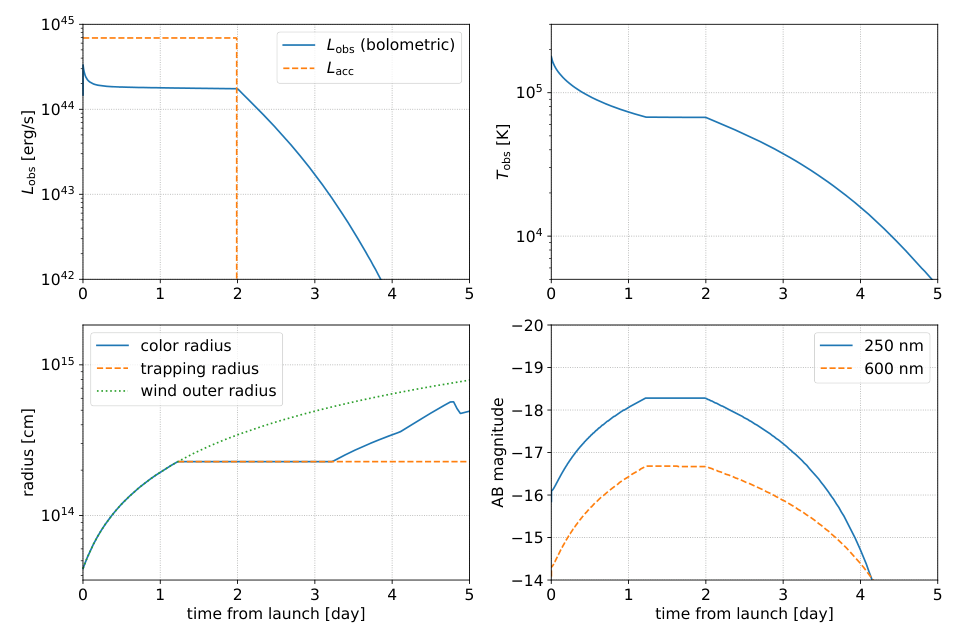
The result is a light curve with a distinctive shape: a rapid rise as the outflow expands, then a decline as the energy supply cuts off. In near-UV bands, peak luminosities reach 10^42–10^43 erg/s; in optical, roughly ten times fainter. Brief and bright, which is precisely what makes them searchable.
The team calculated detection prospects for three upcoming instruments. ULTRASAT, an Israeli UV satellite, combined with ground-based optical follow-up, offers the best odds for nearby events. The Vera C. Rubin Observatory, now coming online in Chile, and the wide-field Argus Array extend reach to redshifts of about z ≈ 0.1, roughly 1.5 billion light-years. TDEs anywhere within that volume could yield detectable flares.
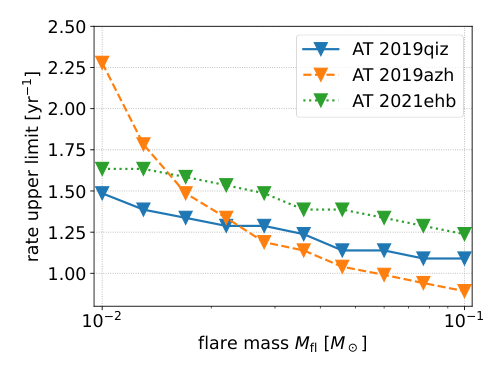
To check their predictions against existing data, the researchers combed archival observations from the Zwicky Transient Facility (ZTF), a high-cadence optical sky survey running since 2018. They searched brightness records of known nearby TDEs for signs of the predicted optical flares. None appeared, but the non-detections are themselves useful.
The upper limits constrain the flare rate for individual TDEs to at most 1–2 per year, depending on assumed outflow mass. Heavier outflows produce brighter but rarer flares; lighter outflows produce fainter but potentially more frequent ones.
Why It Matters
Late-time radio brightening in TDEs is one of the more puzzling open problems in transient astrophysics. Roughly 40% of optically-discovered TDEs eventually show delayed radio emission, implying that outflows moving at roughly 10% the speed of light get launched hundreds to thousands of days after the initial disruption. Something kicks them off late in the game, and nobody knows what.
Disk instabilities are a compelling mechanism, but until now they’ve lacked observable signatures beyond radio.
If the disk instability model is correct, UV flashes should appear just before or during the radio brightening. Catching a TDE with simultaneous UV and radio monitoring during one of these episodes would provide strong evidence that disk instabilities drive the delayed outflows, a direct link between accretion physics and outflow launching. That’s a fundamental test of how supermassive black holes process extreme accretion events.
TDEs are also one of the few laboratories where astronomers can watch a black hole accretion disk form, evolve, and go unstable in real time. In active galactic nuclei, the luminous cores of galaxies powered by feeding supermassive black holes, the same physics plays out over millions of years. TDEs compress the whole story into months.
Bottom Line: Brief UV flares from TDE disk instabilities are theoretically bright enough for next-generation surveys to catch. Combined UV-plus-radio monitoring could finally explain why so many TDEs mysteriously light up in radio waves years after the main event.
IAIFI Research Highlights

This work connects high-energy astrophysics theory with observational survey strategy, using semi-analytical modeling to generate testable, multi-wavelength predictions that bridge accretion physics and real telescope capabilities.

The survey detection framework developed here can inform how AI-driven transient classification pipelines, such as those planned for Rubin, should prioritize UV-optical anomalies in known TDE host galaxies.

The research advances our understanding of super-Eddington accretion and outflow physics around supermassive black holes, probing how gravity, radiation pressure, and disk thermodynamics interact at extremes.
Future coordinated UV and radio monitoring of known TDEs will provide the definitive test of disk instability theory; the paper by Tsuna, Villar, Piro, and Wu (2026) is available on arXiv: [arXiv:2602.15103](https://arxiv.org/abs/2602.15103).
Original Paper Details
UV and Optical Signatures of Late-time Disk Instabilities in Tidal Disruption Events
2602.15103
["Daichi Tsuna", "V. Ashley Villar", "Anthony L. Piro", "Samantha C. Wu"]
Tidal disruption events (TDEs) are unique probes of evolving accretion in supermassive black holes. Recent models of TDE disks show that they undergo brief thermal instabilities with temporal super-Eddington accretion at late times, which has been suggested as a possibility to explain the ubiquitous late radio emergence in TDEs. We model the ultraviolet (UV) and optical signatures of such disk instabilities, expected from the accretion power being reprocessed by the optically-thick outflow following super-Eddington accretion. Our model predicts brief UV-bright transients lasting for days, with luminosities of $10^{42}$-$10^{43}$ erg s$^{-1}$ in near-UV and $10^{41}$-$10^{42}$ erg s$^{-1}$ in optical for a typical TDE by a $10^6~M_\odot$ black hole. These could be detectable by near-future surveys such as ULTRASAT, Vera C. Rubin Observatory and Argus Array, for TDEs of redshifts out to $\approx 0.1$. We further conduct a search for these transients in existing nearby TDEs using data from the Zwicky Transient Facility, placing upper limits on the flare rate for each TDE of $1$-$2$ yr$^{-1}$ dependent on the outflow mass. In the era of future surveys, combined UV/optical and radio monitoring would be an important test to the disk instability phenomena, as well as its explanation for the late-time radio emission in TDEs.